
Adding and Subtracting Decimals to Thousandths Word Problems
Follow a cable length as more arrives or some is removed. Keep all three decimal places, align equal-sized parts, and explain each exchange before writing the final amount.
Each decimal place names a different-sized part
Maya has 12.405 feet of cable and needs to send 3.768 feet to a customer. She lines up the last digits and starts subtracting, but the zero in the hundredths column makes her stop. Before changing any digits, label the places: ones, tenths, hundredths, and thousandths. One thousandth of a foot is a smaller part than one hundredth; the columns cannot be swapped.
12.405 − 3.768 = 8.637
On a small screen, scroll the table sideways to see every place.
| Amount | Ones | Tenths | Hundredths | Thousandths |
|---|---|---|---|---|
| Start | 12 | 4 | 0 | 5 |
| After exchanges | 11 | 13 | 9 | 15 |
| Take away | 3 | 7 | 6 | 8 |
| Remaining | 8 | 6 | 3 | 7 |
Here 12 ones means twelve whole feet. Both 12 + 0.4 + 0 + 0.005 and 11 + 1.3 + 0.09 + 0.015 equal 12.405 feet.
Regroup across a zero one place at a time
Five thousandths are not enough to remove eight thousandths. There are no hundredths to exchange yet, so trade one of the four tenths for ten hundredths. Three tenths remain. Then exchange one of those ten hundredths for ten thousandths: nine hundredths and fifteen thousandths are available.
The tenths column now has three tenths, but the subtraction needs seven. Exchange one whole foot for ten tenths. There are eleven whole feet and thirteen tenths. Subtract from right to left: 15 − 8 = 7 thousandths, 9 − 6 = 3 hundredths, 13 − 7 = 6 tenths, and 11 − 3 = 8 ones.
Every exchange preserves the length. A child who writes fifteen thousandths without reducing the hundredths has added length to the cable. Return to the place-value table and check the total after the trade, rather than only repeating “borrow.”
For addition, combine the same-sized parts
Maya later joins lengths of 6.295 feet and 6.915 feet. The equation is 6.295 + 6.915 = 13.210. Ten thousandths become one hundredth and zero thousandths. The next column has nine hundredths, one hundredth, and the carried hundredth: eleven hundredths become one tenth and one hundredth. Twelve tenths then become one whole and two tenths. The total is 13.210 feet.
The answer key may write 13.21 instead. The final zero in 13.210 changes neither the length nor the arithmetic answer. In this worksheet, trailing zeros indicate place-value notation; they are not a claim about how precisely a real measuring tool was used.
Align decimal points, not the final written digits
When an amount is written as 1.4, rewrite it as 1.400 before comparing it with 2.035. Both still mean the same length as before. Align the decimal points to get 1.400 + 2.035 = 3.435. Putting the 4 under the 5 would combine tenths with thousandths.
Do not round before solving
This worksheet asks for the result using the supplied amounts, not an estimate to the nearest cent or hundredth. Rounding 12.405 to 12.41 and 3.768 to 3.77 first gives 8.64, which loses information from the original problem. Keep the thousandths while calculating. Round only if a separate question asks for a rounded answer.
Check the operation, then check the value
Receiving cable adds to the amount; shipping cable removes some. Confirm that relationship before doing the arithmetic. For 12.405 − 3.768, add the remainder and the shipped length: 8.637 + 3.768 = 12.405. An estimate of about 12 − 4 = 8 also makes 8.637 plausible, but an estimate alone cannot verify all three decimal places.
Read the final answer with its unit: feet of cable. The quantities are lengths, not dollars, so the answer need not have exactly two decimal places. The printed equations keep each input to three decimal places; an exact answer may need fewer trailing zeros.
What this practice includes
Each sheet contains four original addition or subtraction stories. Input lengths run from 0.001 to 20.000 feet, with nonnegative results no greater than 30 feet; the original ranges for the first and second amounts differ. Some values or answers are whole numbers written with decimal notation. Use the working area for the vertical algorithm and an inverse-operation check.
This is selected Grade 6 decimal addition and subtraction practice. It does not include decimal multiplication, division, measurement error, or every requirement of the Grade 6 standard. The answer key gives the final equation and amount, not an automatically generated regrouping diagram for each problem.
Make a practice set
Select the worksheet, answer key, or both. When both are selected, the answer key prints after the questions. Keep it separate if you want your student to work independently.
After your student finishes
Ask the child to name the value of one digit and explain one exchange. Check the answer using the inverse operation and the original unrounded amounts. Accept equivalent trailing-zero notation.
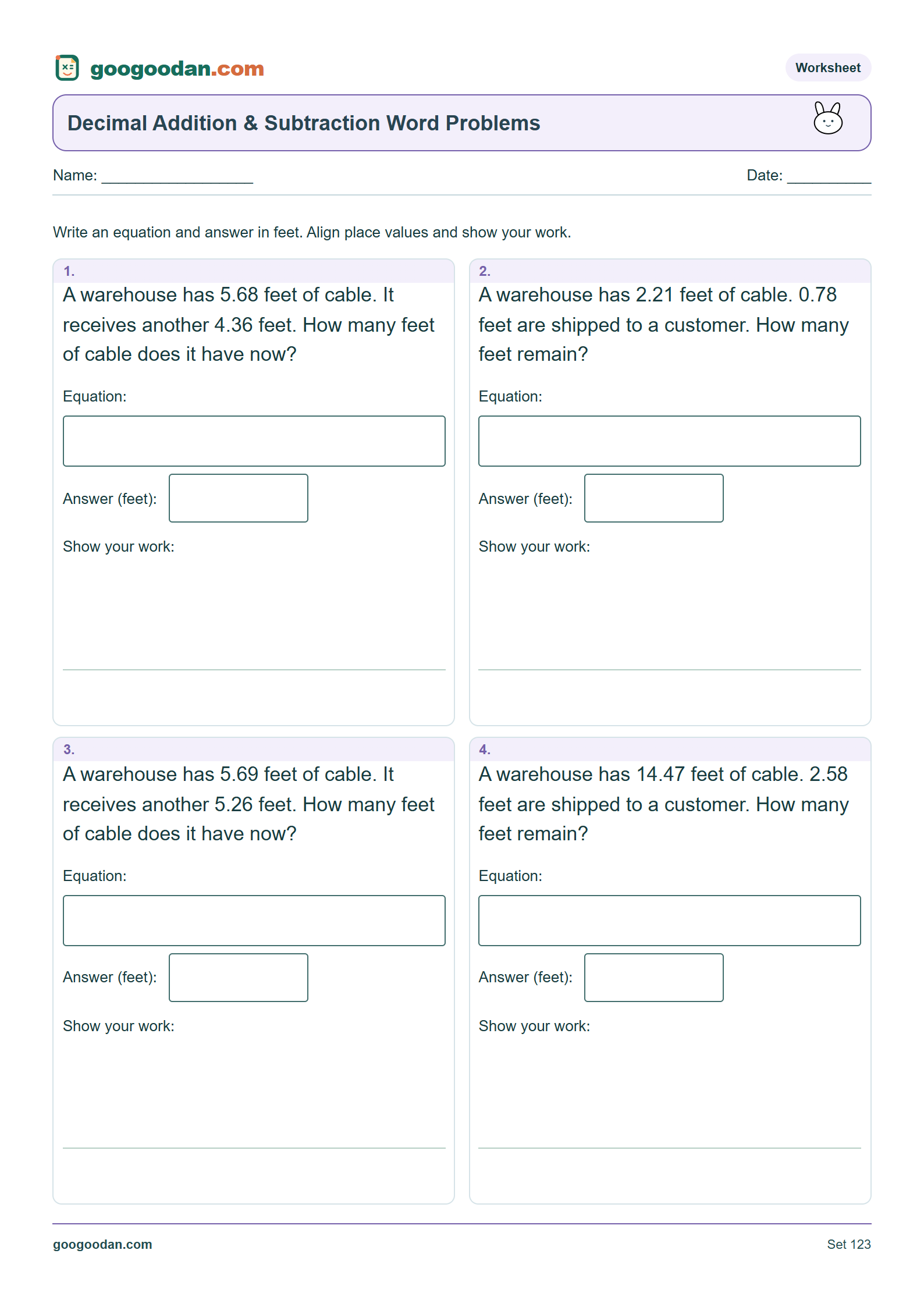 Word problems
Adding and Subtracting Decimals Word Problems
Combine cable lengths or find what remains, using place value through hundredths.
4 problems · Answer key included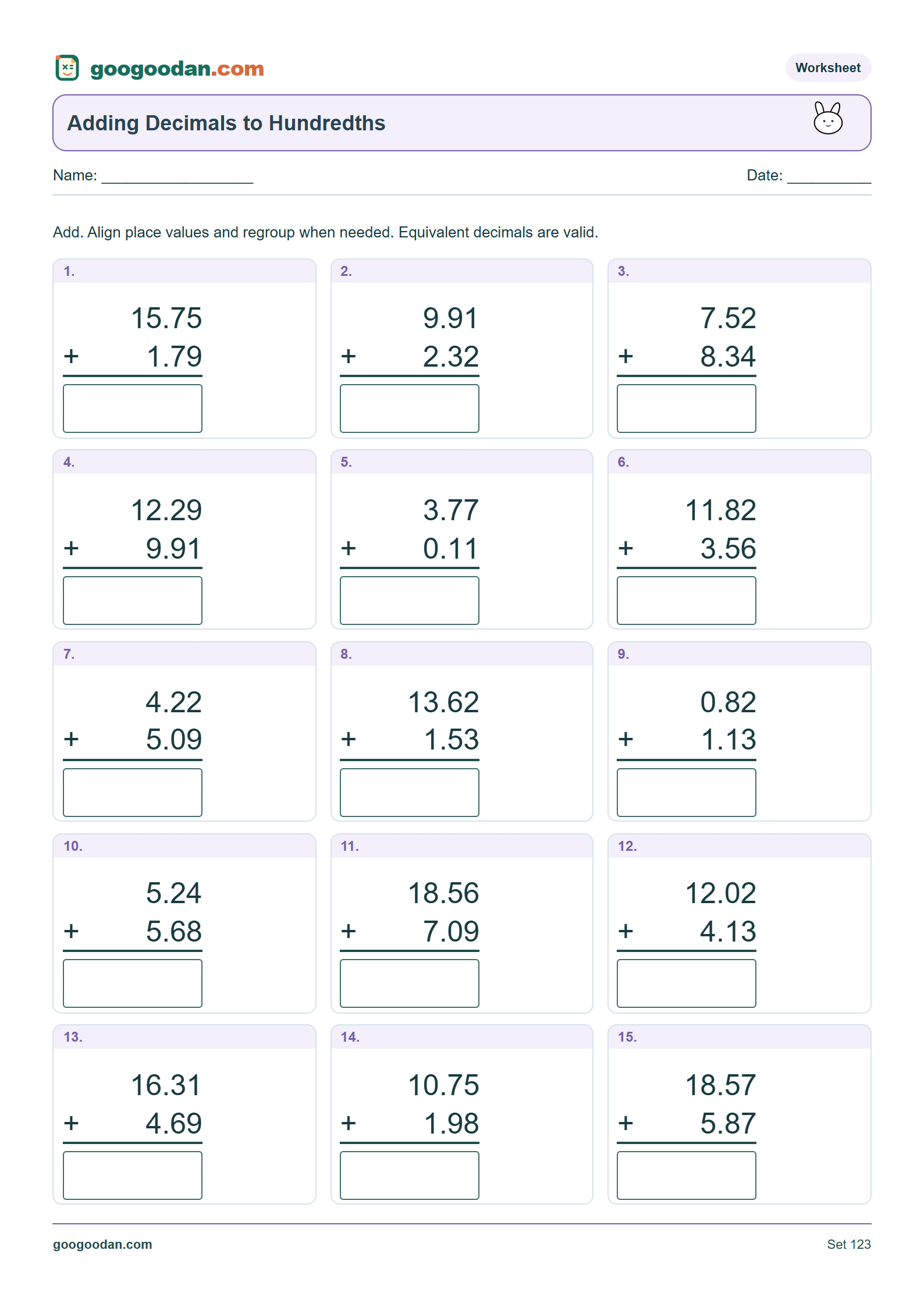 Calculation practice
Adding Decimals to Hundredths Worksheets
Align decimal points and exchange ten hundredths for one tenth.
15 problems · Answer key included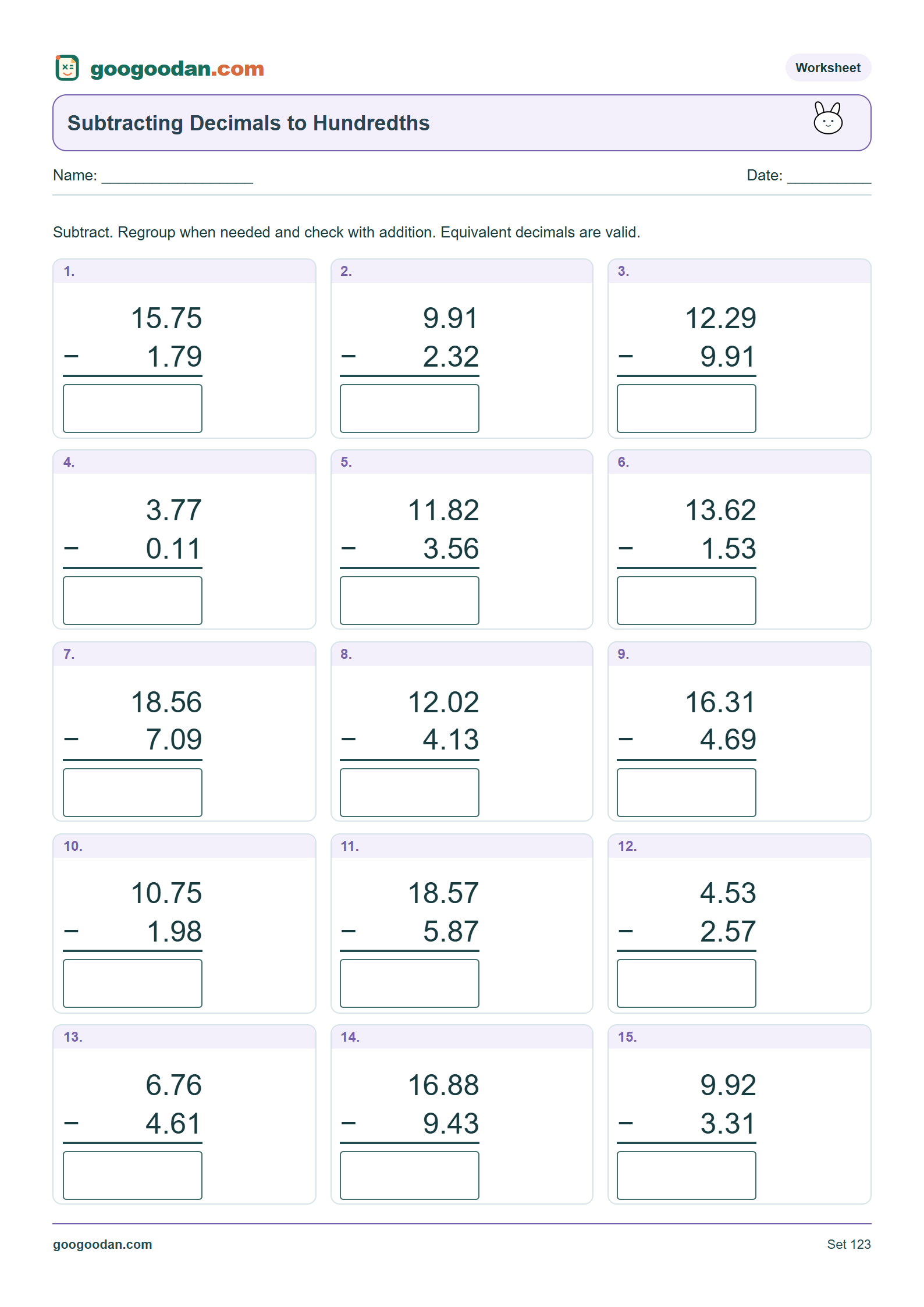 Calculation practice
Subtracting Decimals to Hundredths Worksheets
Align decimal points and rename tenths and hundredths before subtracting.
15 problems · Answer key included
More about addition · Grade 6 worksheets
Grade 6 selected skill connection: Selected 6.NS.B.3: standard-algorithm addition and subtraction to thousandths, supported by place value; decimal multiplication and division are not included in this set. See the Common Core standards for this grade. This worksheet does not cover every requirement in the standard.