
Multiplying Decimals Area Word Problems
Help a child connect decimal multiplication to the space inside a rectangle. Split the sides, account for every partial area, and keep the exact answer in square feet.
Measure the surface, not the distance around it
Maya sketches a rectangular planting space. It is 2.4 feet long and 1.3 feet wide. She adds the two measurements and gets 3.7, then wonders why the answer should be in square feet. The first step is to identify what the question measures: area covers the inside of a rectangle. Length and width describe two directions, so multiply them rather than adding them.
2.4 × 1.3 = 3.12 square feet
- A: 2 × 1 = 2 square feet.
- B: 0.4 × 1 = 0.4 square foot.
- C: 2 × 0.3 = 0.6 square foot.
- D: 0.4 × 0.3 = 0.12 square foot.
Add the four areas: 2 + 0.4 + 0.6 + 0.12 = 3.12 square feet. The letters identify the regions. All four regions use the same drawing scale.
Why there are four partial products
Split 2.4 into 2 + 0.4, and split 1.3 into 1 + 0.3. Each part of the length meets each part of the width. The large rectangle has area 2 × 1 = 2. The right strip has area 0.4 × 1 = 0.4. The bottom strip has area 2 × 0.3 = 0.6. The small corner has area 0.4 × 0.3 = 0.12. Add all four pieces to cover the original rectangle once.
If Maya gets 2.12, she may have multiplied only 2 × 1 and 0.4 × 0.3. Ask her to point to the two missing strips. The picture explains why both cross-products matter; memorizing decimal places alone would not catch that missing area.
Use the same reasoning with hundredths
Now try a rectangle measuring 2.35 feet by 1.24 feet. Split the sides into 2 + 0.35 and 1 + 0.24. The following table records the four areas. It is a calculation table, not a drawing to scale.
| Width × length | 2 ft | 0.35 ft |
|---|---|---|
| 1 ft | 2 | 0.35 |
| 0.24 ft | 0.48 | 0.084 |
The sum is 2 + 0.35 + 0.48 + 0.084 = 2.914 square feet. Keep the thousandths in 0.084. Rounding that piece to 0.08 before adding would change the exact answer.
Connect the area model to written multiplication
Each factor can also be written as a whole number of hundredths: 2.35 = 235/100 and 1.24 = 124/100. First multiply 235 × 124. The partial products are 940 for four ones, 4,700 for two tens, and 23,500 for one hundred. Their sum is 29,140.
Both factors were made 100 times as large. The product is therefore 10,000 times as large, so divide 29,140 by 10,000 to get 2.9140. That equals 2.914. This is why two written decimal places in each factor allow four in the product. A trailing zero can be omitted; a zero between other digits cannot simply be removed.
Check a small factor before trusting an answer
For a strip 3.20 feet long and 0.50 feet wide, the area is 1.60 square feet. Multiplying by one half gives half of 3.20; it does not have to make the numerical value larger. If the child writes 160, return to the half-foot width. As another check, 2.35 × 1.24 must be greater than 2.35 and less than 4.70, because the second factor is between 1 and 2. The exact answer 2.914 fits that interval.
Keep the answer exact and use square feet
The generated problems give side lengths with two decimal places. Their exact products can require up to four decimal places: for example, 7.19 × 5.91 = 42.4929. These are area measurements, not dollar amounts, so there is no automatic rule to keep only two decimal places. Round only when a question explicitly requests rounding.
Feet measure a side; square feet measure the surface. Writing 42.4929 feet leaves the kind of measurement wrong even when the arithmetic is right. A perimeter question would instead add all four side lengths. Have the child label the rectangle and name the required unit before calculating.
How to use this worksheet
Each printable set has four rectangle-area stories from the existing problem bank. Lengths range from 0.01 to 20.00 feet and widths from 0.01 to 10.00 feet; some written decimals represent whole numbers. Use the working space to sketch the rectangle and show partial products or the written algorithm. The answer key supplies the complete equation and exact area. It does not generate a separate area diagram for every problem.
This set is placed with Grade 6 multi-digit decimal multiplication because the full original range includes products beyond hundredths. Students beginning decimal multiplication can first use the tenths-by-tenths practice linked below. This is selected practice, not coverage of all Grade 6 decimal operations.
Make a practice set
Select the worksheet, answer key, or both. When both are selected, the answer key prints after the questions. Keep it separate if you want your student to work independently.
After your student finishes
Ask the child to point to each partial area, explain the decimal scale, and check that the answer uses square feet. Accept equivalent trailing-zero notation. To compare lengths using a unitless multiplier instead of finding an area, try the decimal scaling word problems.
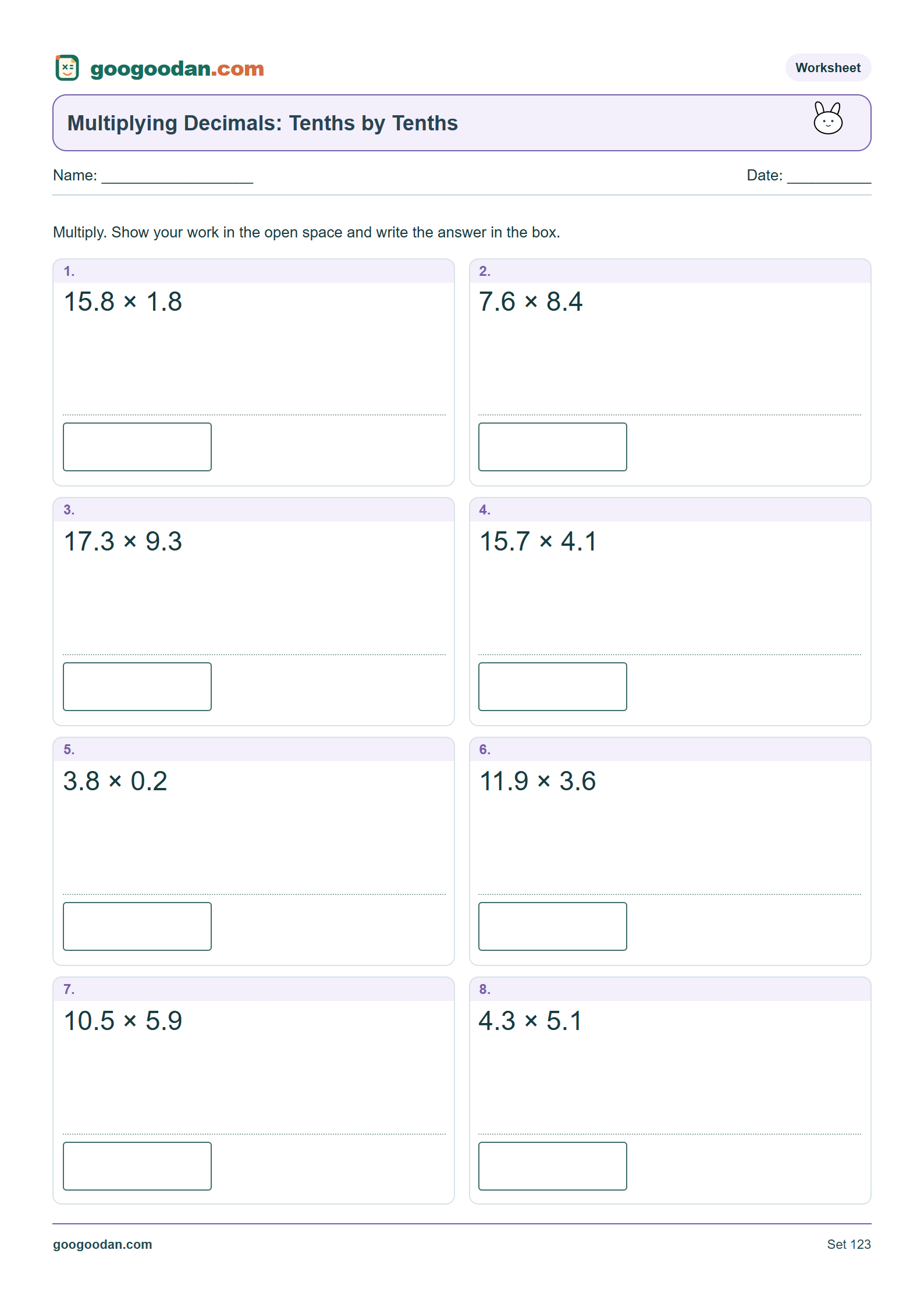 Calculation practice
Multiplying Decimals Worksheets – Tenths by Tenths
Use tenths and hundredths to explain the product, then show your work.
8 problems · Answer key included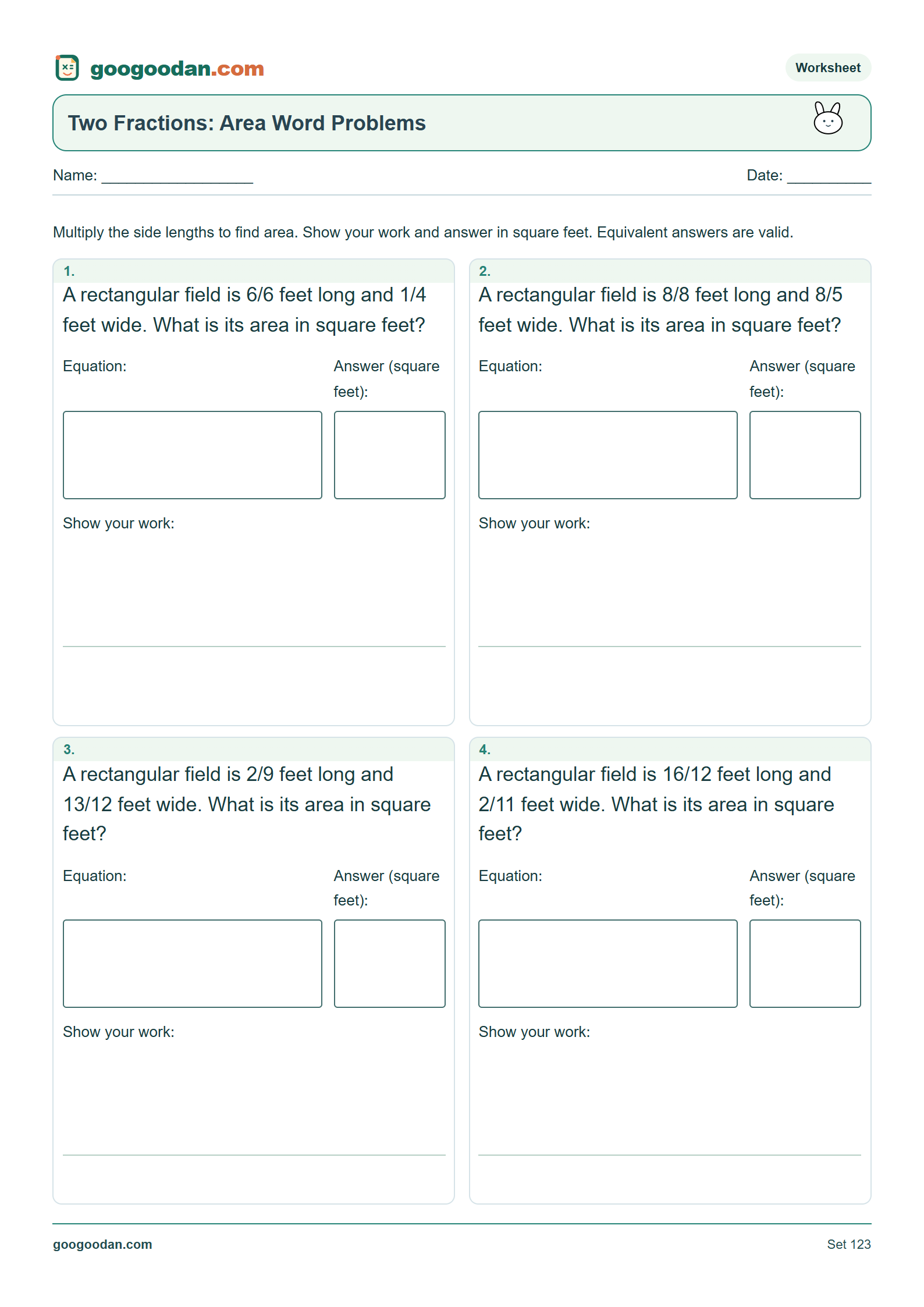 Word problems
Multiplying Two Fractions Word Problems: Area
Find rectangle area when both side lengths are written as fractions; include lengths greater than one foot.
4 problems · Answer key included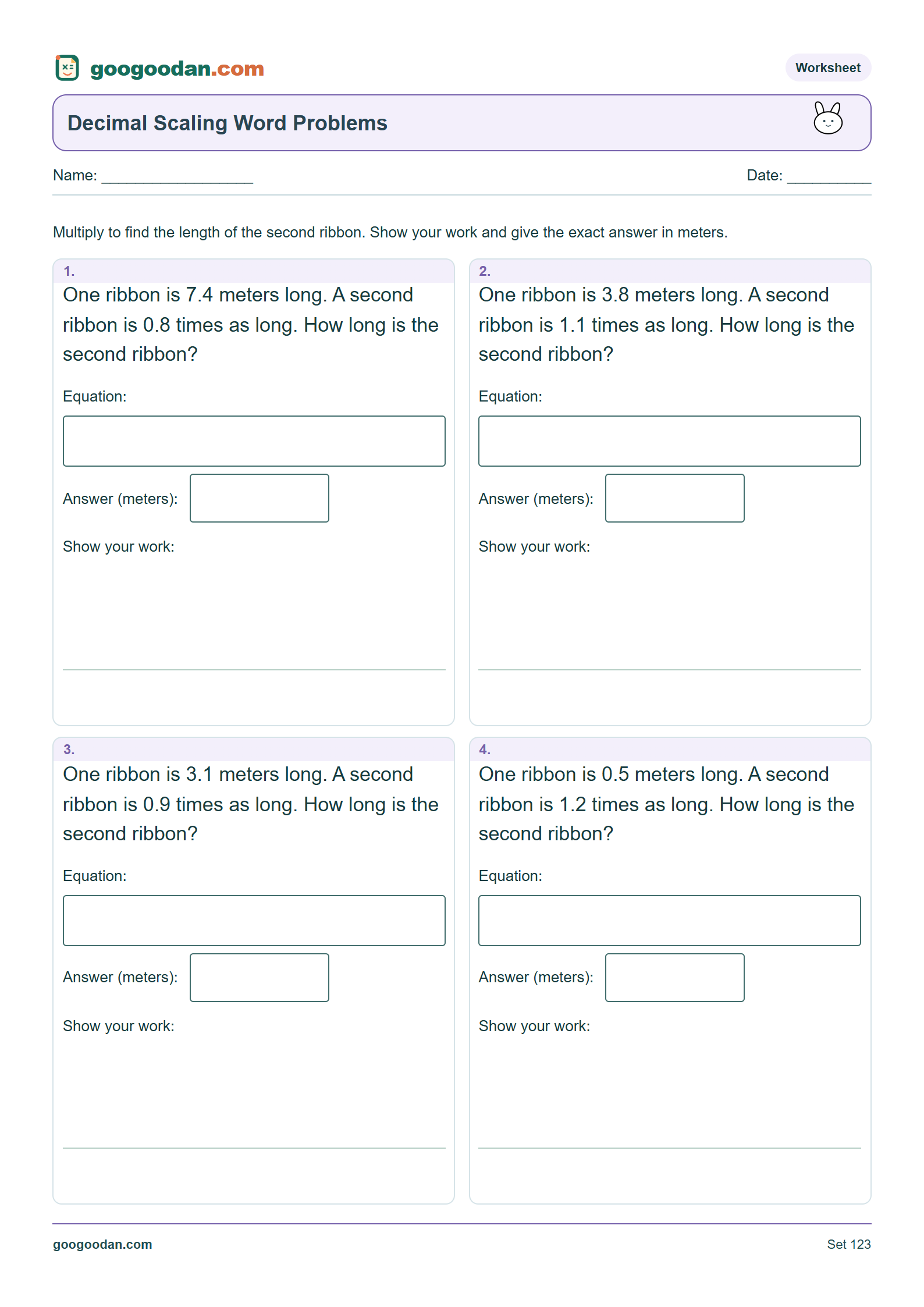 Word problems
Decimal Scaling Word Problems
Compare ribbon lengths using decimal multipliers below and above one. Explain the scale and keep exact answers.
4 problems · Answer key included
More about multiplication · Grade 6 worksheets
Grade 6 selected skill connection: Selected 6.NS.B.3: multiply multi-digit decimals with a written algorithm, supported by rectangle area and place value; input lengths to hundredths and exact products to four decimal places. See the Common Core standards for this grade. This worksheet does not cover every requirement in the standard.