
Least Common Multiple Word Problems
Connect least common multiples to repeating events. Find the first shared flash after the start, justify why it is earliest, and label the answer in seconds.
Look for the first shared time after the start
Noah watches two small lights in a classroom demonstration. They flash together now. One flashes every 4 seconds and the other every 6 seconds. He adds 4 + 6 and predicts that both will flash at 10 seconds. But adding the waiting intervals does not show when either light actually flashes.
Start a clock at zero. The first light flashes at 4, 8, 12, and 16 seconds after the start. The second flashes at 6, 12, and 18 seconds. The first time on both positive lists is 12 seconds. That is the least common multiple, or LCM, of 4 and 6.
LCM(4, 6) = 12 seconds until the next shared flash
Scroll the timeline sideways on a narrow screen. Dots mark flashes; the highlighted column marks the first shared flash after zero.
Why zero does not answer this question
Both lights flash at time zero, so zero is a common multiple. However, the question says they flash together now and asks when they first flash together again. We need a positive elapsed time. Starting the lists at 4 and 6, rather than returning zero as soon as it appears on both lists, keeps that meaning clear.
Ask Noah to point to the starting flash and then move forward along the timeline. At 4 seconds only the first light flashes. At 6 seconds only the second flashes. At 8 seconds only the first flashes. At 12 seconds both do. The order matters: the answer is not just any later common time.
List multiples without skipping an earlier match
Each flash time is a whole-number multiple of its interval. For 4-second flashes, write 4 × 1, 4 × 2, 4 × 3, and so on. For 6-second flashes, write 6 × 1, 6 × 2, and so on. Compare the results in increasing order.
| Interval | First | Second | Third |
|---|---|---|---|
| 4 seconds | 4 | 8 | 12 |
| 6 seconds | 6 | 12 | 18 |
The shared time can occur at different positions in the lists. Twelve is the third positive flash of the first light and the second of the other. Matching only the first entries, then only the second entries, would miss that connection.
A common time is not always the least time
Multiplying 4 × 6 gives 24. Both lights do flash then: 24 ÷ 4 = 6 and 24 ÷ 6 = 4. But 12 comes earlier, so 24 does not answer “first together again.” The product of two positive whole-number intervals is always a common multiple; it is not always the smallest positive one.
For intervals of 5 and 8 seconds, the first common time really is 40 seconds. These intervals have no common factor greater than one, so there is no smaller shared cycle hidden in their product. Students can verify that by listing the positive multiples or by using prime factors. Checking examples before adopting “just multiply” prevents a rule that works only some of the time.
When one interval is already a multiple of the other
If the lights flash every 3 seconds and every 9 seconds, the first light has flashes at 3, 6, and 9. The other first flashes again at 9. The answer is 9 seconds, not 27. Whenever the larger interval is a multiple of the smaller one, that larger interval is already the first positive time they can share.
If both intervals are 7 seconds, the answer is 7: the lights keep flashing together every cycle. If one interval is 1 second and the other is 9 seconds, the answer is 9 because the first light flashes at every whole-second mark. An interval of one is allowed in these worksheets; it should not be discarded as an unusual case.
Use common factors to check the result
Students who already understand greatest common factors can also check LCM(a, b) = (a ÷ GCF(a, b)) × b for positive whole numbers. For 4 and 6, the GCF is 2, so (4 ÷ 2) × 6 = 12. Dividing out the shared factor avoids counting the shared part twice in the product.
This formula is a useful check, but a correct calculation should still answer the story. The GCF of 4 and 6 is 2; two seconds is not a flash time for either light after the start. GCF finds a largest shared divisor, while LCM finds a smallest positive shared multiple. They answer different questions.
Show why there is no earlier positive answer
Before using the answer key, check that the proposed time divides evenly by both intervals. Then look for an earlier common time. For 4 and 6, testing the multiples of 6 before 12 leaves only 6, which is not a multiple of 4. This confirms both parts of the task: twelve works, and no smaller positive time works.
Each printable set contains four original two-light stories with intervals from 1 through 12 seconds. Every story starts with a shared flash at time zero. Use the working space for a timeline, ordered multiple lists, or a justified calculation. Keep the answer in seconds. The answer key shows the first repeat time; it does not draw a separate timeline for each generated question.
This is selected Grade 6 least-common-multiple practice. It does not include lights with different starting times, non-whole-number intervals, three-event schedules, or every requirement of the factors-and-multiples standard.
Make a practice set
Select the worksheet, answer key, or both. When both are selected, the answer key prints after the questions. Keep it separate if you want your student to work independently.
After your student finishes
Check that the time is positive, is a multiple of both intervals, and has no earlier positive match. Distinguish seconds of waiting from the number of flashes.
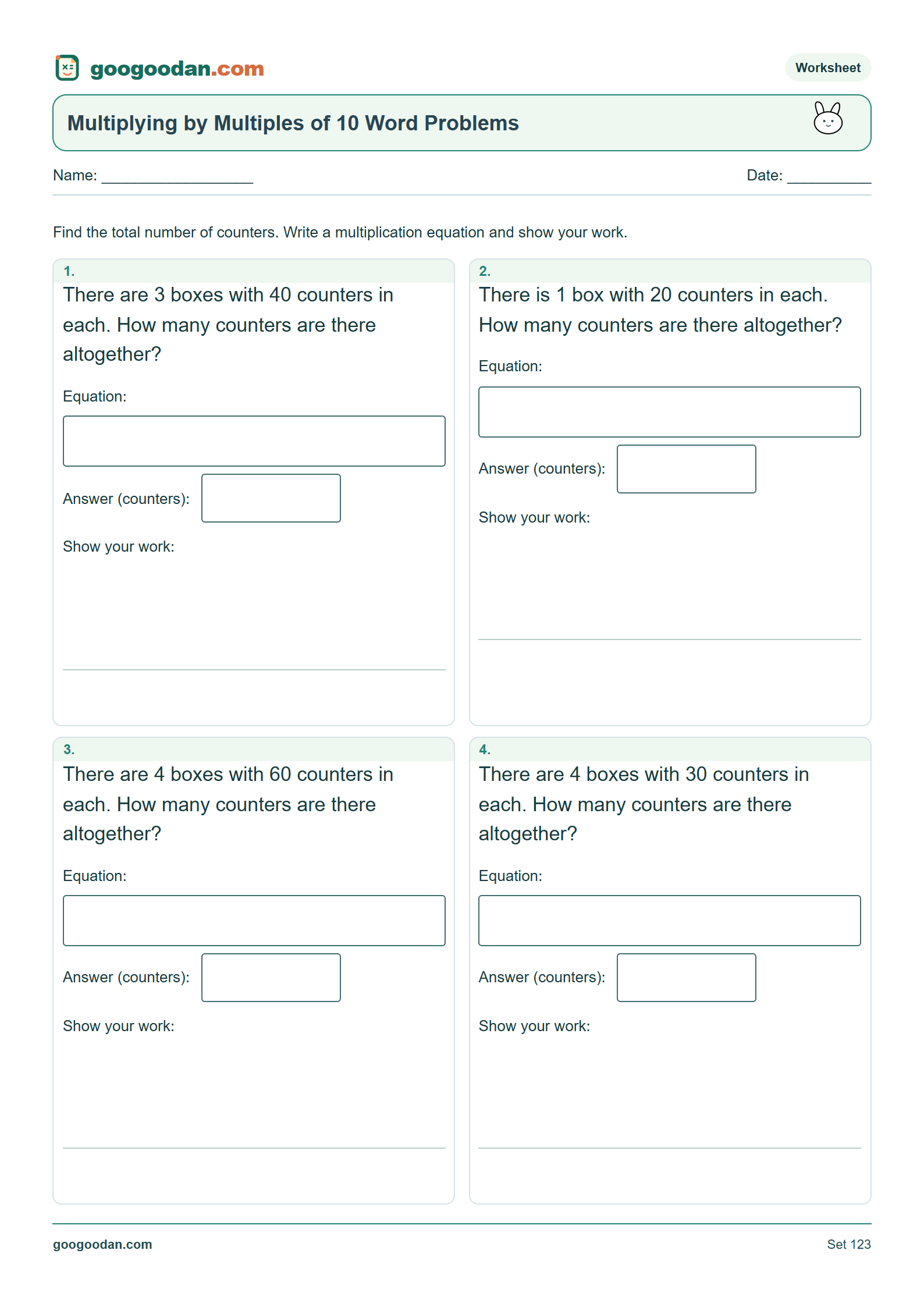 Word problems
Multiplying by Multiples of 10 Word Problems
Count equal boxes of 10–90 counters. Use a known multiplication fact to find the number of tens, then express the total in ones.
4 problems · Answer key included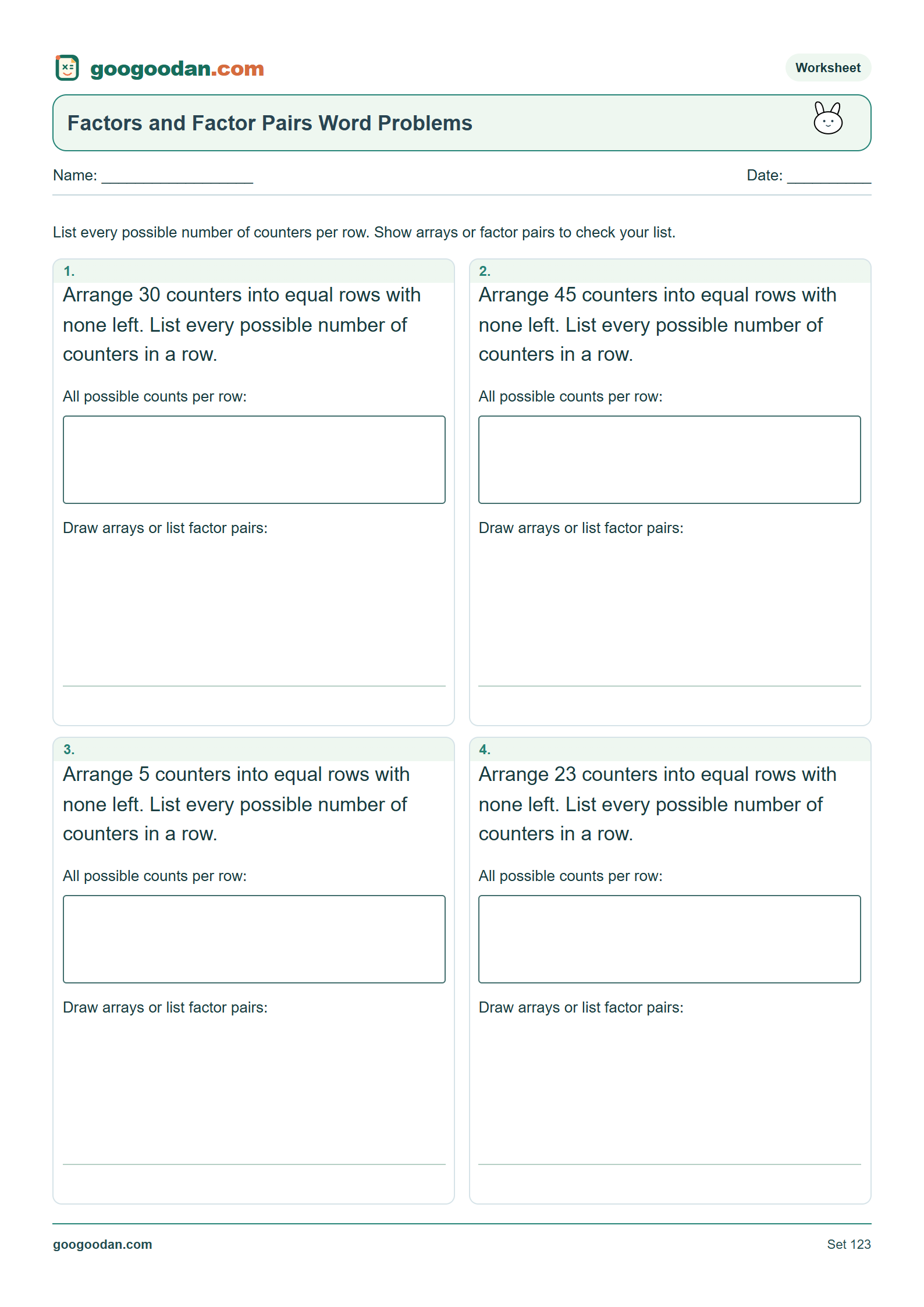 Word problems
Factors and Factor Pairs Word Problems
Arrange counters into equal rows with none left. Find every possible count per row and check that the factor list is complete.
4 problems · Answer key included
More about multiplication · Grade 6 worksheets
Grade 6 selected skill connection: Selected 6.NS.B.4: find the least common multiple of two positive whole numbers from 1 through 12 in repeating-event stories; elapsed time must be greater than zero. See the Common Core standards for this grade. This worksheet does not cover every requirement in the standard.