
Dividing Fractions Word Problems: Partial Groups
Find how many measuring groups an amount makes, including part of a group. Explain why leftover amounts and fractions of a group use different wholes.
A fraction can count part of a measuring group
Mia is comparing amounts with a full-group measure. The measure holds 1 1/2 units, but she has only 6/10 of a unit available. She says, “I cannot fill a whole group, so the answer must be zero.” That would answer a question about complete groups only. This question asks how much of a group the available amount represents, including a partial group.
Use the same unit for both amounts. The available 6/10 equals 3/5. The full group holds 3/2. Since 3/5 is less than 3/2, predict a positive answer below one group before calculating.
Compare equal-sized parts
The upper bar shows a full group divided into fifteen tenths of the original unit. The lower bar shows the six tenths Mia has. Each small section is the same size in both bars. Six of the fifteen sections of a full group are available, so she has 6/15 = 2/5 of a group.
The equation is 6/10 ÷ 1 1/2 = 2/5, or equivalently 3/5 ÷ 3/2 = 2/5. The answer is not 2/5 of the original measuring unit: it is 2/5 of the larger full-group amount. Check by multiplying: 2/5 × 3/2 = 3/5, which returns the available amount.
One full group and part of another
Now Mia has 6/8 of a unit, and each full group holds 2/3 of a unit. Rewrite 6/8 as 3/4. Both quantities can be measured in twelfths: the available amount is 9/12, while a full group is 8/12.
Eight small sections fill one group. One section remains. That remaining section measures 1/12 of the original unit, but it is 1 out of the 8 sections needed for a full group. It represents 1/8 of a group. Altogether, Mia has 1 1/8 groups, which is 9/8 groups.
Why the reciprocal calculation works
For 3/4 ÷ 2/3, measuring both amounts in twelfths gives 9 ÷ 8. That produces 9/8. The written reciprocal calculation gives the same result: 3/4 × 3/2 = 9/8. Keep the total amount first and take the reciprocal of the divisor only.
The reciprocal 3/2 tells how many groups of size 2/3 fit in one original unit. Multiplying the total 3/4 by that groups-per-unit amount counts the groups. Check the result by rebuilding the total: 9/8 × 2/3 = 18/24 = 3/4. Do not flip both fractions or multiply the two original amounts together.
A partial group is not a leftover unit
When the original amount and group size have the same measuring unit, dividing cancels that unit and gives a group count. A fraction such as 1/8 can describe part of a full group even when no complete second group can be made. Keep that interpretation separate from the number of finished boxes, cut pieces, or people.
If the task instead asks for complete pieces only, the meaning changes. This worksheet deliberately includes partial groups and keeps the exact quotient. It does not ask you to discard a remainder, round up to buy containers, or split a person into parts. Use the complete-piece worksheet for exact whole-piece counts.
Estimate and explain before checking the key
Compare the total with the full-group amount. A smaller positive total must give less than one group; a larger total must give more than one. Then find a common measuring part or use a justified reciprocal calculation. A diagram must keep the same scale for the available amount and the group size.
Ask the child to finish the sentence “The total is ___ times the full-group amount.” This connects the quotient to its meaning. An improper fraction and its equivalent mixed number are both valid: 9/8 and 1 1/8 describe the same group count. Neither is a decimal rounding instruction.
What the four printed questions include
Each set contains two answers below one group and two above one group. The total is positive and below 6. The full-group amount is positive and below 3, is not a whole number, and does not simplify to a unit fraction. Answers are positive non-whole fractions below 12.
Displayed values use exact simplified fractions or whole numbers. Their reduced denominators come from 1, 2, 3, 4, 5, 6, 8, 10, and 12. The questions are short number relationships rather than long reading passages. Draw a measuring bar in the work area, write the division equation, and label the answer in groups. These are selected Grade 6 fraction-division situations, not every meaning of division.
Make a practice set
Select the worksheet, answer key, or both. When both are selected, the answer key prints after the questions. Keep it separate if you want your student to work independently.
After your student finishes
Ask what the fraction counts. Multiply the number of groups by the full-group amount to recover the original total.
 Word problems
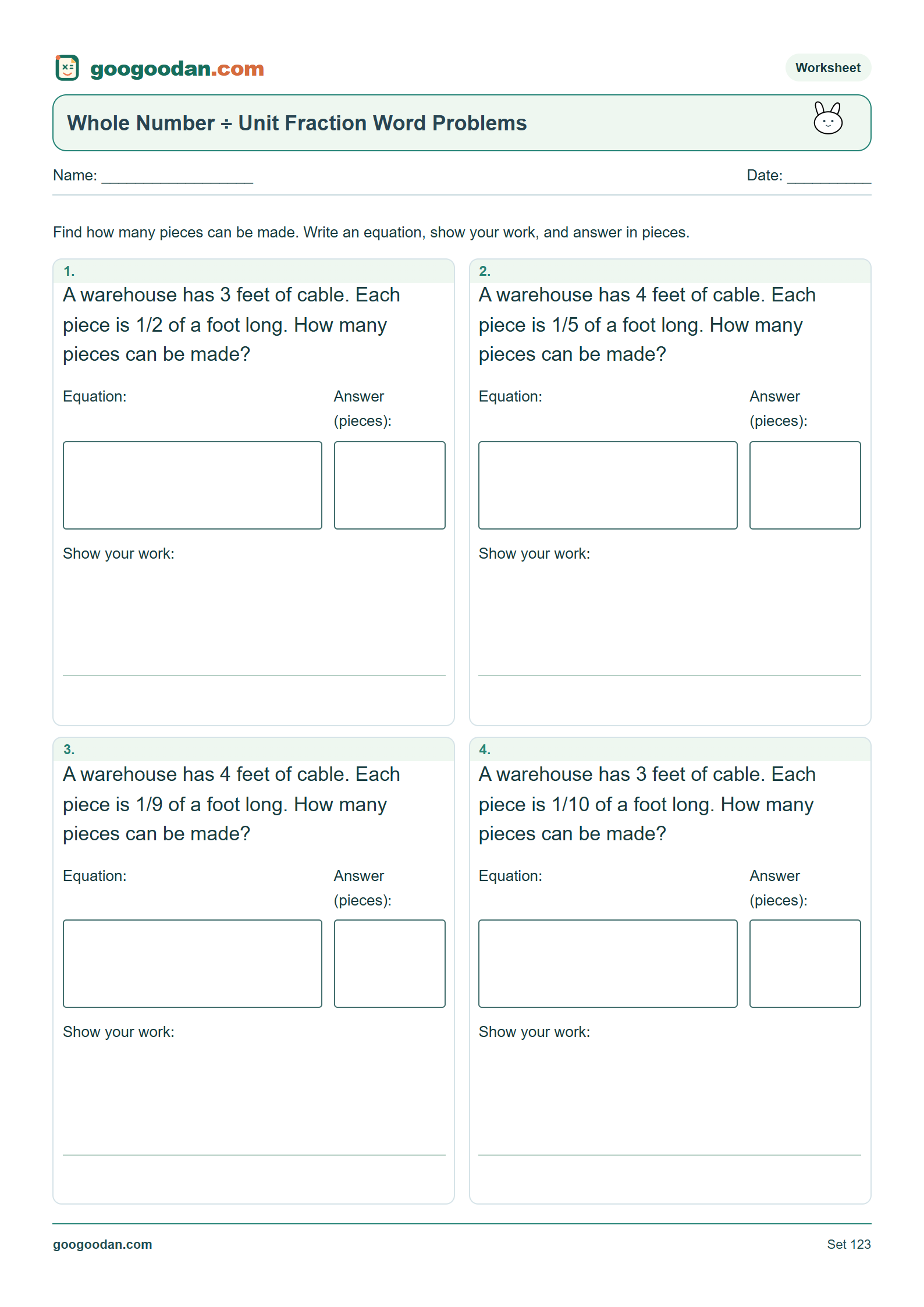
Dividing Whole Numbers by Unit Fractions Word Problems
Count fractional-foot cable pieces in a whole-number length, using equal groups and multiplication to check.
4 problems · Answer key included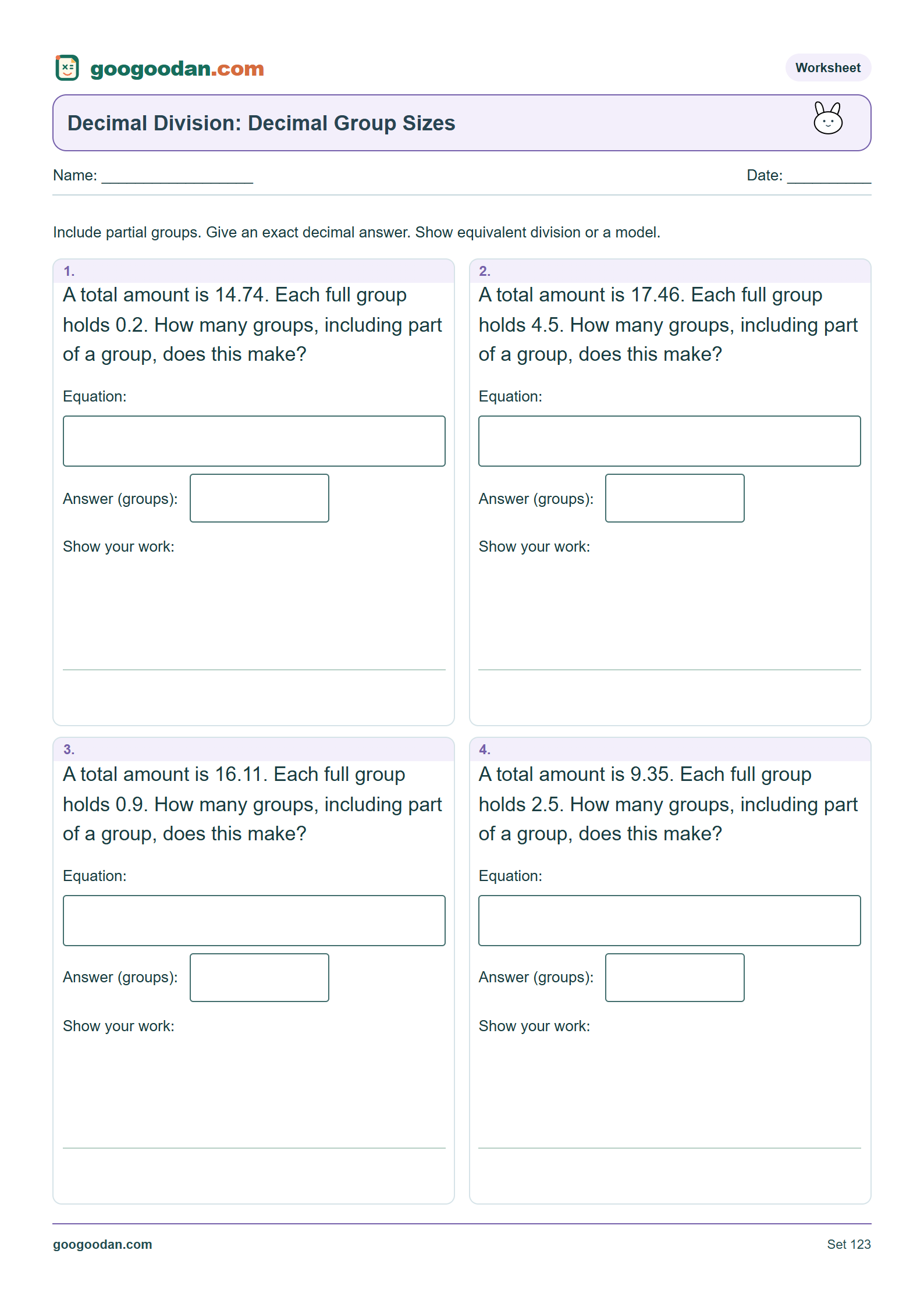 Word problems
Dividing by Decimals Word Problems
Compare decimal group sizes below and above one. Rename both quantities to divide and include partial groups.
4 problems · Answer key included
More about division · Grade 6 worksheets
Grade 6 selected skill connection: Selected 6.NS.A.1: interpret quotients of fractions as measuring groups, including fractional quotients below and above one; use models and multiplication checks. Not all fraction division contexts. See the Common Core standards for this grade. This worksheet does not cover every requirement in the standard.